What is physically true?
Separate a digital claim from independently established physical presence.
The Physical Evidence Gap
We study the evidence digital systems cannot establish alone—and the physical control boundaries institutions need as intelligence becomes more capable.

Synthetic information can be coherent, validly formatted and operationally persuasive. None of those properties independently establishes the person, object or authority physically behind it. 4SI researches that gap.
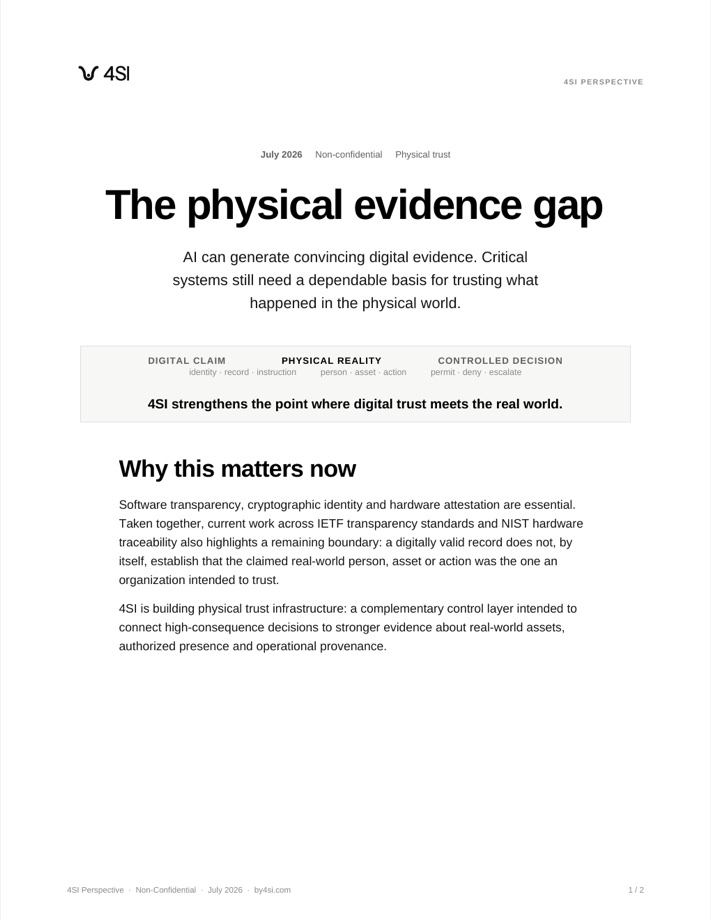
Why digitally valid evidence is not enough for high-consequence systems—and why critical decisions need an independently established physical claim.
The program connects long-horizon control questions with mechanisms that can be evaluated in present-day institutions.
Separate a digital claim from independently established physical presence.
The Physical Evidence GapDefine how accountable human authority can remain attached to consequential software action.
Verification as a control primitiveStudy the digital–physical boundary as an institutional control surface rather than another data source.
Physical trust at the boundary
4SI separates public meaning, testable performance claims and controlled implementation detail. The objective is evidence that institutions can evaluate without exposing security-sensitive mechanisms.
Research method
Our economic work examines where verification failure creates concentrated loss, hidden operational friction and incentives that existing digital assurance does not resolve.
Economic research4SI Intelligence monitors publicly evidenced developments across identity, access, fraud, AI systems and critical digital dependencies. It is the continuous evidence layer beside the longer research program.
Public-source intelligence with explicit provenance, assurance grades and an institutional decision context.
Institutional trust depends as much on what a source does not claim as on what it does.
Trace material claims to identifiable public or controlled sources.
Distinguish observation, inference, design target and verified performance.
Maintain editorial, correction and AI-transparency policies for published work.
Keep public understanding separate from security-sensitive implementation details.
Read the public work, test the assumptions and engage 4SI where the digital–physical boundary matters operationally.